Advocating for NETs

I’m excited to share, as of last week, I have been appointed a Patient Representative with the Food and Drug Administration to represent the Neuroendocrine Tumor community.

This means, I’ll be involved in the official government process of evaluating new drugs and treatments intended to help those affected by Neuroendocrine Tumors. This entails speaking on behalf of Neuroendocrine Tumor patients during clinical trial phases and in public hearings. It’s hard to say when these opportunities to participate will come forth since it depends on what is in the FDA pipeline, but those of us who follow closely could take a couple guesses for 2017.

The FDA has only one Representative per disease, so I feel honored to be the person representing the Neuroendocrine Tumor community and thank the Carcinoid Cancer Foundation for their recommendation.

To learn a bit more about the Patient Representative Network, here is a blog from the FDA’s Acting Commissioner, Robert Califf, MD.

Cancer and Minimalism

87WSyMSm

As featured on curetoday.com

After a lot of thought in December, I decided that what I wanted most out of 2017 is to be more present in my life, something that has been a problem for many years, especially since my cancer diagnosis in 2014. I spend days worrying about the future and reliving the trauma of treatment in my head, which only creates anxiety. For me, I’ve found the best way to cope with this anxiety is to focus on how I feel in the present moment because 99.9 percent of the time, I’m feeling great. I remind myself the moment we are in, right now, is all any of us are guaranteed. As the famous Bill Keane quote goes, “Yesterday is history, tomorrows is a mystery, today is a gift of God, which is why we call it the present.”

Once I resolved to be more present, I started thinking about the tools that would aid me in being successful. One of the to-dos I jotted down on my list was to watch a movie on Netflix called Minimalism: A Documentary About the Important Things. The title intrigued me. I thought you could replace the word minimalism with cancer since the moment you’re told that you or a loved one has the disease, your whole thought process of what is important changes. The Netflix description reads, “People dedicated to rejecting the American ideal that things bring happiness are interviewed in this documentary showing the virtues of less is more.” Cancer survivors know this, but in theory, how much are we focusing on the important aspects of our lives instead of things? None of us will be on our death beds saying, “I sure wish I would’ve gotten the iPhone 7 when it came out.” We’ll be saying things like, “I wish I spent more time with my brother” or “I should have taken that trip to Africa.”

So, what is minimalism? The film’s website describes it as, “a lifestyle that helps people question what things add value to their lives. By clearing the clutter from life’s path, we can all make room for the most important aspects of life: health, relationships, passion, growth and contribution.”

img_2709

A clean, organized book worthy space

If you’re like me and most Americans, you have too much stuff. Inspired by the film, I resolved to declutter. I made a list of the areas in my house I wanted to go through and set my timer for 20 minutes each day. Often, once I got started, I’d spend way more than 20 minutes. Within a few weeks, I decluttered my entire house, donated several bags to charity and remodeled my writing space. While my intention was to organize, I didn’t expect to experience the same radical transformation as the two subjects in the film.

I find myself much happier and living my resolution of being present with ease. Because I am not surrounded with stuff, I can breathe a bit easier. I have less general anxiety, all because my home and life are clean and organized.

Minimalism has also transformed my cancer journey, by making my life more fulfilling. A cancer survivor’s hottest commodity is time, and working towards minimalism has not just resulted in more hours in each day, but has given me quality time I can spend with my husband, friends and chasing pursuits I love, such as writing and yoga.

It has only been a month, so I’m hoping I can continue the lifestyle. My next steps are to reduce my social media presence, tackle digital clutter, comb the house again and unplug the internet one day a week – an idea that might be a hard sell to my husband.

If you’re interested in reducing anxiety, increased quality time with loved ones and pursuing your passions, I encourage you to check out www.theminimalists.com where you’ll find details about the documentary, their podcast, books and social media pages.

To read all my articles with Cure, click here.

Cancer Camp

87WSyMSm

As featured on curetoday.com

During treatment, a fellow survivor friend raved about her experience with an organization called, First Descents (FD). FD is a nonprofit that takes young adult cancer survivors on free adventure trips. Yes, yes and yes. I liked them on Facebook, signed up for their newsletter and went on with the business of getting well.

After surgery and completing chemotherapy, I started to feel more like my adventurous self again. Also around this time, I received an email about First Descents 2016 programs which included rock climbing, whitewater kayaking and surfing at various locations throughout the United States. All of them sounded like fun, but I chose surfing in Santa Cruz, California. I’d never surfed before, but have tremendous respect for the sport. I’d equate watching surfers to watching fire – mesmerizing. The intuition to read the ocean, defy the odds of a wave and staying calm during an inevitable wipe out are all impressive and admirable qualities. Surfing and cancer don’t sound so different.

img_1865

Stunning Pigeon Point Lighthouse (and where we stayed for the week)

Arriving at the San Jose International Airport, I was immediately spotted by the other campers. The short hair and baseball hats are usually dead giveaways for us women cancer survivors. After a curvy drive over the coastal mountains, we arrived at our home for the next week – Pigeon Point Lighthouse on the Pacific Coast Highway. It was a stunning location.

img_2280

Cowell’s Beach in Santa Cruz

The next day, we arrived at Cowell’s Beach in Santa Cruz and were lead by Richard Schmidt’s Surf School. Little did we know then what a legend Richard Schmidt is in the surfing community. Surf Splendor Podcast even called his school, “the oldest and most prominent in the world.” Richard and his instructors were extremely kind, humble, encouraging and considerate to our motley crew and we all felt honored to be taught by masters. Once we got our wetsuits on and a beach quick lesson, we were let loose in the water. The first day, I struggled and never got up on my board. Surfing is hard for a strong, fit person, but it’s even harder when you’ve been taken apart and pieced back together by surgeons like many of us had been. We all kept at it and to my surprise, the next day and the rest of the week, most of us were able to get up and ride some pretty sick waves, as they say. A day of surfing was reminiscent of how you feel as a child after a day of swimming – happy, satisfied, starving and exhausted.

Some of my favorite moments throughout the week had nothing to do with surfing, but from being in a group where I could joke about cancer. This is not something I’m able to do too much in my regular life because it’s usually met with a stern “not funny” look from my husband or other family members. We all cracked up when someone made an origami fortune teller and joked that’s what doctors use to determine the number of rounds of radiation and chemotherapy. Or demanding to see a port scar as a means of entry into our living area. Laughing about having cancer flare-ups to protesting something we were about to do. Joking that if you put all our body parts together, we made up a whole person. How refreshing it is to be in the company of people who could actually understand these types of morbid jokes and genuinely laugh with you.
img_1955

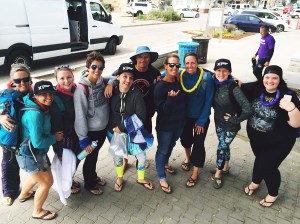
The ladies with Richard Schmidt

Another powerful moment was when us girls stood in the living room revealing our scars. Mine have never been seen by anyone other than my husband and medical staff, so this was pretty big. I saw many nipple-less breasts and they saw my ginormous abdominal scar, which is the shape of a Mercedes-Benz logo (the actual surgical incision name). It was a liberating moment and I would’ve never done this with any of my non-cancer friends.

I’ll remember this experience and the stories of my brother and sister cancer fighters forever. First Descent’s motto is “out living it.” We had all been through so much, but were still here, out living what has killed others, together, in more ways than one and that was pretty rad, as they say.

“Life should not be a journey to the grave with the intention of arriving safely in a pretty and well preserved body, but rather to skid in broadside in a cloud of smoke, thoroughly used up, totally worn out, and loudly proclaiming ‘Wow! What a ride'” – Hunter S. Thompson

To learn more about First Descents, check out their website at www.firstdescents.org

Read this on curetoday.comCancer Camp

Read all my articles with Cure.

img_2279

The “Minimavs” Team