The Anxiety Reduction Plan

outlivingit

As featured on First Descent’s Out Living It blog

This blog was featured on First Descent’s Out Living It blog. First Descent’s is a non-profit that offers young adult cancer survivors (FREE) adventure trips where they learn the healing power of community and nature through participating in activities such as kayaking, rock climbing and surfing. In September 2016, I attended a First Descents Surf Program in Santa Cruz, California. Read about that here. If you’re interested in learning more about this wonderful organization, check out their website, https://firstdescents.org.

If you’re reading this, you don’t need me to tell you that cancer is a sneaky trickster. The disease invaded every corner of my life and just when I think I’ve got it figured out, it jumps up and grabs me from behind. It’s latest surprise – anxiety.

I was diagnosed three years ago. In retrospect, it’s pretty incredible anxiety only recently crept into the equation. For some reason, I thought I would get by unscathed by this common side effect of cancer.

My relationship with anxiety started one morning in March. I woke up to a missed call from my doctor’s office. It wasn’t even my oncologists office, but the mere presence of a doctor’s number in my call log triggered a misfire in my brain causing me paralyzing fear. I could not do anything the entire day but obsess about how I was going to suffer and die. Instead, I spent my waking hours crying, clenching every muscle and felt as if my lungs were closing in on themselves. The next day, I was fine.

A few weeks later, it happened again.

I often see articles suggesting anxiety victims to relax, exercise, meditate, get enough sleep, focus on the positive, etc. Admittedly, I might have even doled out some of this terrible advice myself in the past. After much thought, I realized the reason this is bad advice is because it’s not specific enough. Talking with my therapist, she explained that in the midst of anxiety, our brains do not function sufficiently where we can even come up with ideas to make ourselves feel better. She then urged me to create an Anxiety Reduction Plan consisting of specific activities I can execute when anxiety strikes. Here’s what I came up with for myself:

Go for a walk, run or to yoga
Call a friend to hang out
Memorize, write out and repeat to myself (I can now recite three Maya Angelou poems, the seven axioms of yoga teacher training and countless famous quotes)
Do a (yoga) forward fold (this pose has been proven to reduce anxiety)
Close my eyes and take 10 (or 100) deep breaths
Write a reminder message on my hand (“You’re okay,” is my go-to)
Write a list of 100 things I’m grateful for
Clean the fridge, floors, garage (I love organizing)
Go to a park with some markers and a coloring book
Send a card or gift to someone I’m thinking about
Do a random act of kindness
Paint something
Take a bath or shower (something about water and being clean makes me happy)
Create and execute a schedule (7-7:30 drink coffee and catch-up on news, 7:30-8 shower and get ready, 8-12 work, 12-1 lunch, etc., etc. Sometimes, I just go through the motions, but it’s better than obsessing all day)

Now, when I wake up and feel the walls closing in, I pull out my sheet of paper and start running down the list. As a disclaimer, I’ll admit that going through these motions does not always take away or reduce the anxiety, but for stretches of time I am redirected, which provides doses of solace.

As it turns out, my therapist and I are not on the brink of discovering a new physiological method. I recently listened to the Good Life Project podcast and later found a Ted Talk describing the approach the American Psychological Association calls, Positive Activity Interventions. Their studies also show being told or trained to “think positive” and/or confronting past trauma isn’t enough. Instead, their research revealed consistent simple actions, such as those listed above, not only make the miserable less miserable, but, over time, reinforce positive states of mind and improve levels of happiness.

So, what’s on your plan? Now, write it down, fold it up and put it in your wallet. Hopefully you’ll never have to use it.

Listen to The Good Life Project podcast: On Awe, Positive Actions, Anxiety and Depression

Read the full study, Upregulating the positive affect system in anxiety and depression: Outcomes of a positive activity intervention

Watch the Ted Talk, The New Era of Positive Psychology:

7 Yoga Truths for Cancer & Life

Summertime will always put me in a reflective state. It seems to be my season of challenge, transition and transformation after being diagnosed with a Pancreatic Neuroendocrine Tumor in 2014.

This time last year, I was deep into my 30-day, 200 hour yoga teacher training “intensive”, which is the most accurate description of the experience. I have never pushed myself more physically, mentally, spiritually and emotionally. I cried therapeutic tears everyday and was surprised how much unresolved trauma I had stored in my body because of cancer. It was the best gift I have given myself and I graduated the program with so much more than a deeper understanding of the physical practice.

One of the many concepts that resonated with me during the 30 days was the Seven Axioms of Teacher Training. Over the last year, as I’ve continued to ride the rollercoaster of illness, these universal truths have been comforting reminders.

  1. You’re exactly where you’re suppose to be. This is a hard one to accept when an illness is involved. When I was sick, if someone said this to me, I probably would’ve punched them in the face, but now, I get it. I would give back cancer in a nano-second, but that means I would also have to give back the meaningful friendships I’ve created, the completion of the El Camino de Santiago, yoga teacher training, my career as a writer, my role at the FDA, my thirst for adventure, etcetera. All these wonderful things are a result of cancer. So, am I exactly where I’m suppose to be? Unfortunately and fortunately, yes.
  2. Fear and pain are life’s greatest teachers. Do I need to say anything more? I have learned so much from illness because it has brought on fear and pain I never realize existed and through that same fear and pain, I have learned how to live and not just exist. Cancer has taught me that I am so very strong, resilient and courageous, a word that makes me roll my eyes. I have been able to do things I never thought I’d be able to do because of cancer. For instance, before cancer I coward at the idea of needles. Now, I could give myself an injection while climbing a mountain at the same time. Cancer has also taught me deep compassion for my fellow humans. Others are often shocked when I tell them how the disease has impacted my life because I look like a normal, healthy, 37-year-old.  This is proof we never know what others have going on based on outward appearances and for that, I am kinder to people.
  3. Laughter and play are the fountains of youth. I find nothing fun about cancer. I often say it is the opposite of fun. But, I think within the non-fun, it is important to keep laughing and retain a childlike sense of play. In moments where it’s too hard to keep things light, call for backup. My husband is a major source of keeping me laughing and has succeed to make me smile in dark moments. When he’s not around, I watch YouTube and am surprised how much time I can spend watching puppy videos.
  4. Exercise and rest are the keys to vibrant health. We all know this, yet, so many of us ignore it. Before cancer, I exercised like crazy, at the expense of sleep. I believe, sleep deprivation was a contributing factor to my diagnosis. Now, I make sure I get at least eight hours and move my body every day. I wouldn’t describe myself as having vibrant health, but I would say I am more fit that the average person, which has been one of my secrets to managing a chronic illness.
  5. Touch and intimacy are basic human needs. We’ve all seen the study about babies who do not thrive when they are not touched and cuddled, yet, as we grow older, we assume that need dwindles. If you’re unwell, you should double-up the hugs and love.
  6. Everything is impermanent. For me, this is the most powerful axiom. It’s context is that everything is temporary. We all walk around with an illusion of control, which is not the case. When you look deeply, you will see that there are no guarantees. Health is temporary. Sickness is temporary. Happiness is temporary. Sadness is temporary. One of the reasons loss of anything is so hard to accept is because we do not expect change. We want our lives to continue on without any uncomfortable interruption. And when the interruption occurs, we are surprised and hurt. Accepting that everything is impermanent has given me great comfort. It has made the natural ups and downs easier to accept. And most important, it has taught me to live each day as if tomorrow is not guaranteed, because it is not.
  7. Everything is connected. I vividly remember the days and weeks after surgeries and chemotherapy concluded. I felt this euphoric connection to everyone and everything down to the core of my bones. Perhaps it was a high level of relief, trauma or PTSD, but I was so happy to be alive and enthralled with everything. I would go for a walk in my neighborhood and notice the tiniest, most beautiful things I never realized were there. I’d often come home with tears streaming down my face and my husband looking at me as if I’d lost my marbles. Everything seemed magical. While some of the feeling has faded, the memories remain evidence that we are all connected to everyone and everything whether we notice it or not.

Whether you are impacted by cancer, another illness or life challenge, I hope these axioms give you the same pause, solace and perspective they have for me.

Read all my articles with Cure.

My Double Life

The Mount LeConte Lodge in the Smokie Mountains is a special place only accessible by foot and booked a couple years in advance.  I had never heard of it, but when my Camino group was lucky enough to secure a reservation for July 7th, I jumped at the chance. Little did I know the hike would be on the heel of a new chapter in the cancer saga.

In May I had my first Gallium-68 scan (read about that here), which revealed disease not detected in my previous MRIs. I knew something was going on due to my blood tumor marker results and onset of facial flushing, a common symptom of Neuroendocrine and Carcinoid Tumors. My specialist, Dr. Edward Wolin, recommended Peptide Receptor Radionuclide Therapy (PRRT).  While PRRT has been done with much success for 20+ years in Europe, it is pending FDA approval in the United States. Fortunately, there is a clinic in Houston (Excel Diagnostics) who has been granted permission to perform this treatment. With Dr. Wolin’s help, I was able to get scheduled this week (July 10-14) after the 6-week waiting period from my last Lanreotide injection expired. Because the treatment is not approved, we are not sure if it will be covered by insurance and guess what?  It ain’t cheap. So, please stop here and join me in saying a prayer that insurance will do it’s job.

With the Mount LeConte adventure scheduled two days before the Houston departure, I contemplated if the hike was a smart idea and (quickly) concluded that as long as I felt good, I was not going to let cancer ruin yet another life plan.

At 6,593 ft (2,010 m) Mount LeConte is the highest peak in Tennessee and one of the highest in the Appalachian Mountains. I decided I should do a little training so I spent some time at Radnor Lake climbing up and down the ridges. During those hikes I felt awesome and ready for Mount LeConte, but on Independence Day, I was pooped after only 750 feet of elevation giving me reason to doubt myself. Backing down doesn’t compute in my brain so I told doubt to get lost as I packed my backpack full of gear and short acting Octreotide injections which I take three times a day now that my Lanreotide has run out.

IMG_3944

8:20 and ready to climb

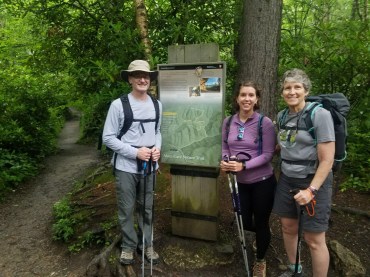
There are a few trails to Mount LeConte and my husband and my(reluctant)self picked Alum Cave, which happens to be the shortest, but most difficult of the routes. Our group of four departed the trailhead at 8:20 a.m. It rained the night before and most of the hike was a walk upstream. Alum Cave is described as scenic but I couldn’t see anything due to fog. I was grateful for ignorance during the often stretches of metal cable on my right and an invisible drop on the left. It was hard. I was sweaty and tired, but 11:30 a.m. we strolled into the Lodge to find ourselves the first arrivals of the day. Put that in your pipe and smoke it, cancer.

IMG_3959

The Lodge was an experience! We were told to bring our own towel, which I incorrectly associated to a shower. When the receptionist bragged about a hot water spigot and flush toilets, I knew wi-fi was out of the question. It turned out to be a welcomed change of pace. Once the fog cleared, the vistas and quiet were appreciated. With sunrise came blue skies and a leisurely, but fast, descent from the top of Tennessee. At the bottom of the mountain, we packed up, stopped for lunch and headed home to our wonderful indoor utilities with enough time to re-pack for today’s (July 9th) departure for Houston.

I am so grateful to have spent some time disconnected in nature which provided me with the opportunity for noise-free reflection. This trip had me thinking about how I am full of contradictions and extremes. One day I am climbing mountains and the next day I am off for a cancer treatment. I am stronger and in better shape than most, but not healthy. I climbed up the mountain in the fog and down in the sun. I have no in-between. No average. No middle-of-the road. No even keel. I love this. I hate this. Who wants to be average? Me. I would love to be normal, but then again, I probably wouldn’t.

As always, prayers, thoughts and good vibes for the treatment to be successful are appreciated.  An offering to the insurance Gods would be welcomed too.

Upward and forward.

NET Friends – Stay tuned for blogs on my PRRT experience at Excel Diagnostics in Houston.

This slideshow requires JavaScript.