Lessons Learned in Advocating During Your Cancer Treatment

87WSyMSm

As featured on curetoday.com

“You have to be your own advocate.”

We’ve all heard it before, but when it comes down to it, being your own advocate means so much more than bringing a notebook to appointments, being knowledgeable about your disease and asking questions. When it comes to cancer, we’re not advocating for a bike lane on main street. We’re advocating for our families, happiness, feeling good and our lives.

I have always had a bold personality with no reservations about being a pain in the behind, so advocating for myself was a natural instinct. While I know there is still a lot to learn, I give partial credit to my advocating abilities for living today with no evidence of disease.

We all have different tactics to insure we’re receiving the best possible care for ourselves or our loved ones. Here are some of the important advocating lessons I’ve learned along the way:

I got many opinions. I know this goes without saying, but the more I talk to other survivors, the less I hear this actually done.  If I had stuck with the first and second opinions, I would not be feeling as good as I do today. I figured since I and my insurance company would be paying them a lot of money, it was my right, as a paying customer, to interview doctors as if they were applying for a job. The position was saving me.  Not only were their answers to my questions important, but I also considered their experience, personality, accessibility and whether they would be a good fit on Team Stacie. Also, I learned the hard way that liking a doctor, does not mean they’re right for my team. I wanted the best doctor for my disease, not a best friend.

I found a leader. I wanted the very best, which to me meant a doctor who lived and breathed the disease I was facing. Someone who leads clinical trials, knows the cutting edge treatments and can answer my questions without needing to look them up. Eventually, I found a specialist in a neighboring state with over 30 years of experience and patients who credited him as the reason they’re alive today. My doctor only works on neuroendocrine cancer and has not only championed treatments through FDA approvals, but is also up-to-date on the latest promising treatments in other countries. As the captain of Team Stacie, he develops the game plan and works with a local oncologist in my hometown.

I email my doctor. In today’s world, we shouldn’t rely on appointments and phone calls. I find when I call a doctor during the day, they are with patients or unavailable. Therefore, I send a email with a question or request for them to call me along with a list of what I’d like to discuss. If it’s quick and easy, I let them know they can respond via email and a phone call isn’t necessary. My specialist is older and not so email friendly, but his nurse is happy to play the middle man. Beware of a doctor who won’t provide you good access to them.

I’m on my team like white on rice. All healthcare professionals are busy people and I can see how patients slip through the cracks when doctors are working, on average, 60+ hours a week. However, my life depends on not slipping through the cracks, so I am respectfully stuck to my doctors hip like glue. I won’t hesitate to call, leave a voicemail and follow-up with an email, day after day. The result, my doctors know this and are always quick to return my call, if only to get me their off their back. When we do connect, I acknowledge their lack of time and express my sincere gratitude.

I learned my disease inside and out. Thanks to living in the information era, I connected with many patients affected by the same disease who shared their decades of wisdom. However, I do not believe my ability to Google overrides the knowledge in my team of highly trained medical professionals. While going through treatment, I leaned on my team and Google to teach me how to read lab results and reports. Before I am called into an exam room, I’d pull these up on my iPad to discuss with my doctor or nurse. I’ve even been known to impress a couple interns, nurses and assistants with my level of knowledge, which I take as a compliment.

I leaned on my closest allies. There were times when I was so sick, I just wanted to get out of the exam room and into the treatment room. During those days, I leaned on my husband to ask the questions and advocate on my behalf. I also have a friend who has been through her own health challenges and offered to become my legal advocate should the situation arise. Another possible line of defense I considered was a third party, trained health advocate. Before cancer, I wasn’t aware such an occupation existed.

Above all, I trust my gut. I have learned so much since my diagnosis, but one of the most important lessons is to trust my gut. More than ever before, I am in tune to what my instincts and body are saying. In the past, when I rebelled against these internal compasses, I was always sorry. I constantly check-in with how I’m feeling and talk to my body as if it were a separate entity. Deep down, I know what is best for me and it’s my job to communicate with my team.

Advocating for yourself can be exhausting, but your life depends on not letting your guard down for a moment. Be heavily, unstoppably and unapologetically engaged in your health and you could be rewarded with the best gift of all: life.

Read all of my Cure Today articles


Waiting for Hair: The Toll of Chemotherapy and Cancer

87WSyMSm

As featured on curetoday.com

My impatient husband is waiting for me to finish doing my hair. We’re meeting friends for dinner and already running late. This used to be a regular scene at my house on any given weekend night.

Now, I’m bald. I think about this as I sit at a coffee shop and look around at all the healthy people flaunting their hair — mocking me with curls, highlights, ponytails, bobby pins and headbands — while they run their fingers through their locks with no thought. I am green with envy and feel guilty for taking my beautiful hair for granted.

Image

Free at last from the heat of a Nashville summer.

I acknowledge hair loss is a difficult and traumatic event for many during cancer treatment. For me, losing my hair wasn’t hard — it was the waiting for it to grow back that has been the most challenging. I finished my last chemotherapy treatment on Christmas Day and was irritated not to wake up December 26 with a full head of hair.

When I started chemotherapy, my doctor gave me three options of cocktails and explained the potential side effects. I asked her which one she thought would be best.

She gave her opinion and followed it up with, “It’ll give you crazy diarrhea and it’s the most toxic but you won’t lose your hair.”

Really? I was shocked my doctor thought I would rather endure weeks of diarrhea just for hair. On my first day of chemo, the pharmacist and I reviewed the side effects again. I decided to go with a less toxic cocktail at the expense of my hair. Up to that point, I only thought “hair” only meant was on my head. It was then that I learned I could lose everything. Yes, everything. 

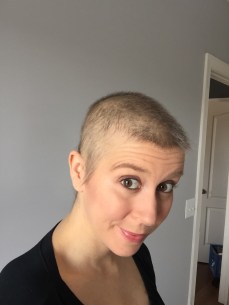
Two weeks after my first treatment, I ran my fingers through my hair and out came a handful. Within the hour, I called some friends to come over to shave my head. We made a celebration out of the event and created many styles. I had a mohawk over salad, a side shave over pizza and a nice patch in the front with a curl over dessert. No tears were shed, but there were a lot of laughs. Eventually, we shaved it down to a nice stubble and it felt great during that Nashville summer.

Even though I bought a wig and countless people sent me scarfs, I decided to be out and proud with my bald head. As if it were any consolation, I have a nicely shaped head without any Gorbachev birthmarks or funky lumps. I often forgot I was bald and people are pretty cool these days about not staring too much. A fellow survivor even bought me lunch once.

Much to my surprise, the stubble stayed and I never got Mr. Clean bald. Angry, I wondered if my shave was premature. Remembering everything, I stopped shaving my legs, until my husband said the hair was braidable. And even more annoying — that one hair growing from my chin. You ladies know what I’m talking about. I welcomed the loss of that little sucker. Nope, it never happened and I’m still plucking that rebel. Eyebrows, eyelashes and everything else remained in tact.

Halfway through my six rounds of chemotherapy, I got a two month break from chemotherapy for surgery. I was ecstatic when my hair started to grow back and continued to do so even after I resumed treatment. I thought that maybe I wouldn’t lose my hair this time. Sure enough, the day after the thought existed in my brain, I woke up to a softball-sized bald spot on the back of my head. I resolved not to do a complete shave and just let it be.

Today, I’m almost a couple months from the end of treatment and my hair is the definition of a hot mess. Picture a combination of cradle cap, a modest mullet and that terrible men’s hairstyle that looks like a wall at the front hairline. I’ve been wearing hats and oozing with jealousy at everyone and anything who has hair. This includes my German Shepherd and cat who just shed it throughout the house. I take a picture of my head every day and even though I feel my hair growing back, it doesn’t look like it in the photos. A watched pot never boils.

Having a buzzcut for the last six months is starting to take it’s toll. I am so ready to run my fingers through my hair again. No matter how many times my husband tells me I’m pretty, I still do a double take when I pass a mirror. I feel less feminine and despise how my bald head screams cancer patient. I’m ready to move on.

Who knows when my hair will grow back to what I consider a respectable length. But what I do know is that I can’t wait for one of those weekend nights, when we’re already late and my husband’s waiting for me to finish doing my hair.

Read on curetoday.com: Waiting for Hair: The Toll of Chemotherapy and Cancer

Read all my cure today.com articles.

A Chronology of Hair Loss

IMG_4023

February 10, 2016


Defeating Cancer Using the Law of Attraction

87WSyMSm

As featured on curetoday.com

In 2007, I was introduced to the law of attraction through the book, “The Secret.” Using the tips and tools the book provided, I became intentional about what I wanted out of life. Through asking the universe and believing I would receive, I attracted many things I had been dreaming of for years. Love, traveling, money — it was all mine and I was loving the life I had created for myself. So, I tossed “The Secret” on my bookshelf and floated on through my perfect life.

Fast forward to September 2014 when my dream life turned into a nightmare after I was diagnosed with cancer. How could I go from having it all to having it all taken away? We all have the illusion of control in our lives, but this was something I was not able to fix and it drove me crazy. If I could be diagnosed with cancer, anyone could. Then I realized that while I don’t have control over my final outcome, I do have control over my thoughts, feelings and actions. So, I dusted off my copy of “The Secret” and renewed my law of attraction practice.

The law of attraction is a philosophy that states that what you focus on comes into your life, whether it is positive or negative. The book’s author, Rhonda Byrne, explains how we must ask for what we want, believe it is possible and be grateful once we receive. Below are some of the ways I use the law of attraction in everyday life to take back the control of my mental, emotional and spiritual health.

I choose my words. I refuse to own disease. It’s not mine. I didn’t ask for it and I don’t want it. Thus, I never refer to it as “my cancer”, but rather, “the cancer.” However, I do refer to, “my healing” and “my recovery” because I want to own those things.

The vision board and visualization. Years before I was diagnosed, I began creating vision boards. This is where photos of my dreams and goals live. It’s a bulletin board placed in front of my desk, where I see it everyday and visualize myself fulfilling each dream and achieving each goal. I don’t worry about how the dream or goal will happen. I focus only on the end result. A couple times a year, I revise what is on the board. At this time, I spend a few minutes on each picture and express gratitude for its realization or future realization. Then I remove, add and rearrange according to what I’d like to focus on in the near future. Every time I edit my vision board, I’m amazed by how much has come to fruition.

Express gratitude. Every day, I mentally list or write down all the things and people for which I am grateful. A day does not pass where I don’t express gratitude for my healing, my perfect health, the perfect health of my organs, my husband, my life, for feeling good, my doctors, my pets, my family, my friends and so on. I also take this time to say thank you in advance and send love, health, healing and positivity to everyone I’ve encountered who is in need. I do this on my daily walk, before I fall asleep, during an MRI and while sitting in the waiting room at the doctor’s office. This practice always leaves me feeling happier and in a good state of mind.

Wite-Out is my friend. Last fall, I had to cancel my plans for a girls’ weekend in Paris due to chemotherapy. To excercise my travel insurance, I needed my oncologist to write a letter explaining my medical status. I have since found the letter and used white out to change my situation from, “due to her chemotherapy schedule and adverse effects, it is not advisable for her to travel,” to “due to her perfect health, it is advisable and recommended for her travel.” This letter hangs in front of my desk so I can see it every day. I’m also planning on going through my medical records with my trusty white out pen.

I say “YES!” When I hear a story of someone who has overcome a dire health situation, I say “Yes!” After sitting in the waiting room and listening to a woman call several people to share the news that she is in remission, I said “Yes!” in my head and mentally cheered her on. When I read that Jimmy Carter’s cancer is responding to treatment, I scream “Yes!” In my previous life, I may have been jealous, but I know saying “Yes!” creates good karma and tells the law of attraction that I want this too.

I keep my mouth shut. I do my best to not talk about cancer. I know, it’s easier said than done for all of us who have had our lives impacted by the disease. But I don’t want to waste my days on E arth giving cancer any more time, attention and energy after it has already taken enough. When someone asks for an update, I share the bare minimum and then change the subject to something positive.

I surround myself with Tiggers. We all have Eeyores in our life and I’ve made an effort to kindly and respectfully stop spending time with them. This past summer, I was really sick and wasn’t practicing what I preach. It was hard to be upbeat and positive while vomiting for half the day. It was then that my army of Tiggers swooped in to fill my negativity trench up with positivity. At the time, I found them annoying, but looking back, I would not be alive if it weren’t for all my Tiggers. They really are wonderful things.

Above all, I believe. This is the key and more important part of the process. I believe, with every cell in my body, that whatever I want is possible. If you’re facing an incurable disease, know that every disease has been incurable at some point in history. I intentionally seek out stories of people defying the odds, overcoming prognoses and doing the impossible. I know these people overcame because they believed they could and not the opposite.

I know what some of you are thinking: “Cancer is serious, real, hardcore stuff and no matter how positive someone is, people do die.”

I know this, but I’d like to think a positive person who kept themselves open to miracles lived longer than someone who was negative and closed. I believe there is a mind-body connection and I welcome all forms of healing.

Ultimately, I understand I may not have control over the final outcome of my physical body. However, doing these activities gives me control over disease mentally, emotionally and spiritually. And most importantly, I’d prefer to leave this Earth knowing I exuded love, positivity and possibility — all of which are things needed in today’s world more than ever.

Read my other articles with Cure.