The Power of Words

outlivingit

As featured on First Descent’s Outliving It http://outlivingit.com

 “Sticks and stones may break your bones, but words will never hurt you,” was a phrase uttered in my household growing up. This was usually preceded by an insult or verbal nastiness from a cousin or sibling. With all due respect to the adults who doled out this prescription…Worst. Advice. Ever.

Words do hurt and have the power to evoke the strongest emotions. Chances are, if you’re reading this, cancer has been one of the most powerful, painful, transformative, definitive words of your life. It’s a word that takes less than a couple seconds to say, but it’s effects permeate a lifetime.

Through personal trial and error, I’ve found that after spending some time thinking about the vocabulary, it is possible to transfer some of the control from cancer to myself, which is a welcomed feeling considering how powerless cancer makes me feel. I’ve also learned that the vocabulary is different from person to person. If you’re not sure where to start, below are a few of the guidelines I’ve created for myself when talking cancer. Hopefully some of these will get you inspired to create your own list.

I have chosen to not to claim cancer. Don’t want it. Never have. Never will. Therefore, it’s not “my” cancer, but “the” cancer. “I don’t have cancer,” but “there is cancer inside my body.” Sure, it’s a play on words, but this is how I make sure cancer knows it will never be mine no matter how hard it tries. Like, ever. Also, something about the word “patient” makes me feel helpless, which is why I refer to myself as a “survivor”, which makes me feel powerful.  This is a label I attached to myself the day I was diagnosed and not the day I heard, “no evidence of disease.” There are many definitions to “survivor” but it’s pure context is, “to endure or live through (an affliction, adversity, misery, etc.)” so I am surviving no matter my current medical status.

One of the many things cancer has taught me is that most people do not know how to respond when I tell them how it has impacted my life. I can easily predict the deer in headlights look as the person searches for the right words. Naturally, they respond with a cliched, pre-packaged, canned and sometimes offensive response. I totally get it. I used to be this person. I still am this person sometimes. Cancer is so awkward and uncomfortable. However, what I have found useful is to tell my friends and family what’s up, ahead of time, if possible, through an email message, so they have time to process and formulate a response.  In addition, I’ve also found it helpful to tell them what they can say to encourage and support me. Doing this has made it easier on both of us. Our friends and family want to be a source of encouragement and support and it’s unreasonable that we expect them to say the right thing when they have no idea what we need or want to hear. Here’s a couple suggestions I’ve used in the past:

Instead of saying, “I’m so sorry you’re going through this,” I ask that they say,  “I know you have the strength to get through this,” because I do. The former invokes feelings of pity, while the latter makes me feel strong and supported. I also asked for my supporters not use battle language or tell me to beat it, stay strong or positive. My feeling towards these phrases is that they imply if I just try a little harder, then I will be healed. Being the recipient of these words only invokes feelings of guilt if I don’t beat it or have the inevitable and normal periods of weakness or negativity. Cancer is not a matter of trying hard enough. And when all else fails, I enjoy the honest simplicity of, “I don’t know what to say.”

And for the love of all that is holy and sacred in this world, please, I beg of you, to not saying that someone, “lost the battle” if they pass away. We don’t describe death from heart disease, freak accidents, natural causes etc. in this manner. Using this phrase implies if the person only fought harder, they would have not died.  Loser’s lose which is the exact opposite word I would use to describe someone who’s been through cancer treatments. Those impacted by cancer endure surgeries, toxic chemicals, crazy side effects – cancer survivors are hard core, bad-asses. The strongest of the strong. Not defeated losers. In fact, in the Sorcerer’s Stone, Dumbledore wisely says, “Death is but the next great adventure,” which seems like a fitting description for those in the First Descents tribe, who have passed on.

Again, these are the terms that work for me. Just like every cancer is different, the words we find comfort and power in will be different. I encourage you to spend some time thinking about your vocabulary and once you’ve built your dictionary,  tell your support team.

This blog was featured on First Descent’s Blog, www.outlivingit.com. First Descent’s is a non-profit that offers young adult cancer survivors (FREE) adventure trips where they learn the healing power of community and nature through participating in activities such as kayaking, rock climbing and surfing. In September 2016, I attended a First Descents Surf Program in Santa Cruz, California. Read about that here.

Nerding Out on NETs in NYC

img_3647

Me with the Godfather

My six month check-up with my Neuroendocrine Tumor (NET) specialist, Dr. Wolin, in New York City happened to coincide with Big Apple NETs support group Luncheon with the Experts.

As always, it was wonderful to connect with other NET survivors and hear their stories. However, being able to ask questions of some of our communities champions, was pretty incredible. The most notable of the panelists was Dr. Richard Warner, who I’m calling the Godfather of NETs. He was accompanied by two knowledgeable colleagues, Dr. Lynn Ratnor and Dr. Jerome Zacks. During lunch patients were allowed to ask general questions regarding treatments, surgery and lifestyle. Some of the major topics included:

Familial links – This was an especially timely topic for me as I just had an email conversation with a NET survivor, whose sibling also had a NET. Everything I’ve ever read indicates it is not a hereditary disease and Dr. Warner’s opinion is that there are links. He thinks this will be a hot topic in coming years as the incident rates rise for NETs. Then this week, the Healing NET released some information on a clinical trial looking for enrollees on this topic.

Diet and Alternative Treatments – The general consensus of the panelists was that these methods should not be used alone, but in conjunction with treatments. And that patients should be cautious to not negatively impact any proven treatments. Dr. Warner did share some of his opinions regarding foods (and other things) that impact carcinoid syndrome:

  • Nasal spray
  • Dental shots with epinephrine
  • Alcohol (Specifically port wine was mentioned)
  • Fermented foods such as ripe cheeses, herring, etc.

Note: I’m sure this list should be longer, but these are the items he mentioned.

There was also discussion about products such as CBD oil, alkaline water, plant based diets and excluding sugar. Being the scientists that they are, they would not stand behind anything that hasn’t been studied and proven.

Gallium-68 – There was some discussion and explaination about this newly approved scan and it’s ability to detect small tumors often undetectable by CTs and MRIs. The Carcinoid Cancer Foundation has put together a nice page of information and locations where this is available.

Xermelo – A newly approved drug to be used in conjunction with Lanreotide or Sandostatin for uncontrolled carcinoid syndrome. Read the FDA approval here.

It was a really nice few hours and I did learn some new things.

Then Monday, I had my very first Gallium-68 scan at Albert Einstein-Montefiore Cancer Center and wanted to chronicle the process for others.

Setting up the scan wasn’t too complicated. The most unnerving part was when I was told I’d have to pay upfront for the test and they would reimburse when/if my insurance covered the scan. Fortunately, my insurance came through at the last minute and I did not have to cough up $3,400. Can we all just pause for a moment and say, Thank You to the Insurance Gods.

I received several calls ahead of time cautioning me this is an extreme fast for four hours. Normally, I fast for six, so four is a walk in the park. After my Uber dropped me off at the wrong address, in the Bronx, in the rain, I eventually figured it out and made it just in time to my appointment.

I was called back right away for them to start an IV, which is always a fun process for me since I’m hard stick. Normally, the average number of sticks is four and they did it in three, so that’s pretty good.

img_3657

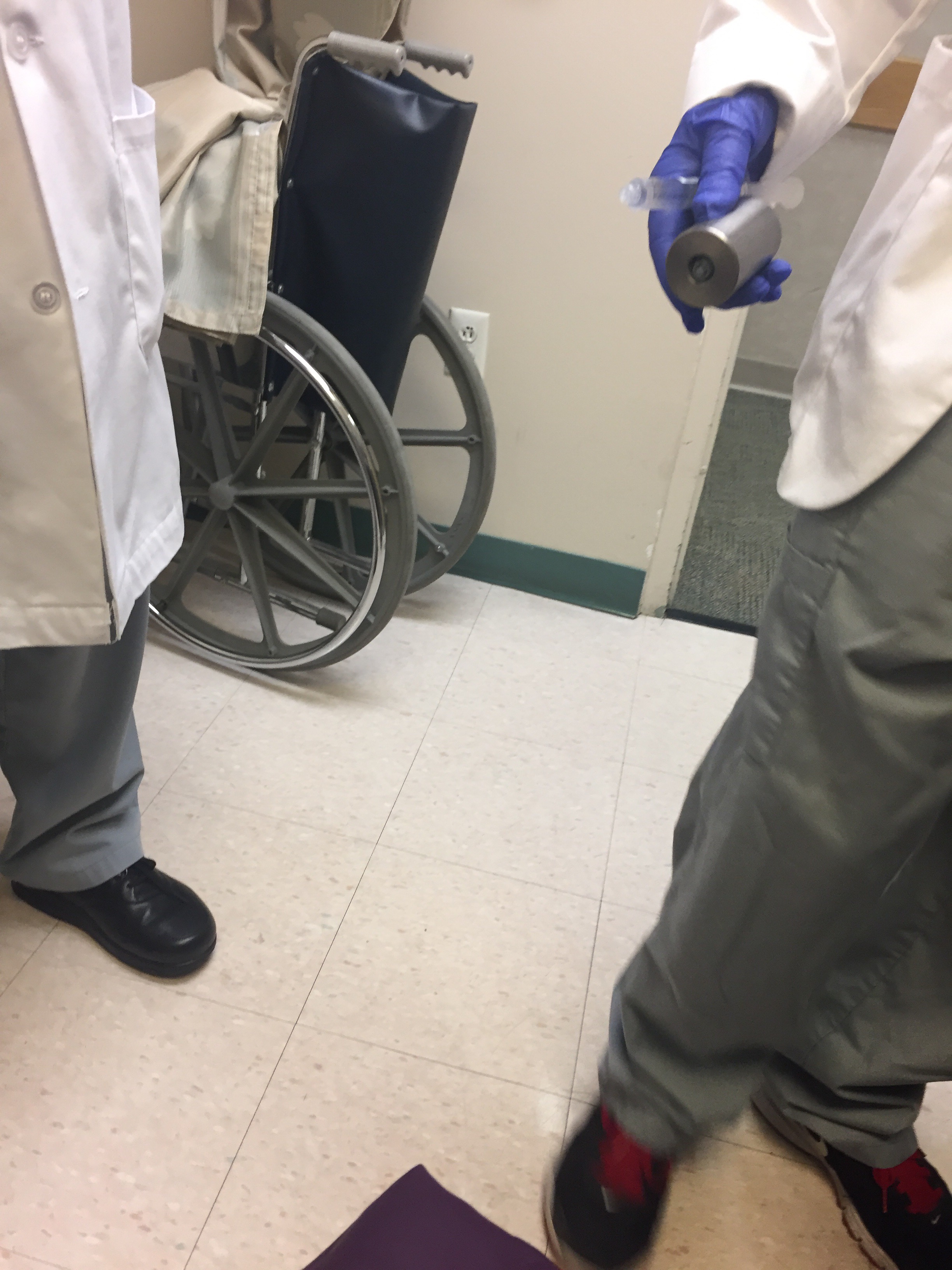
Just a little metal tube of radiation, NBD. 

As soon as I was hooked up, two gloved doctors appeared with a thick metal tube full of radioactive liquid they injected into my veins. It wasn’t long, but it felt like fire going through my veins. They told me that’s unusual, which is becoming the story of my life. I was cautioned sometimes people can become nauseated after the injection. Fortunately, that did not happen to me.

After they emptied the tube, everyone quickly left the room and I relaxed and read as radioactivity flowed through my veins.

An hour later, someone showed up to escort me into the scan room.

As far as the actual scan, it was a piece of cake, compared to an MRI. There was plenty of room between my body and the machine.  The hardest part was lying still with my arms above my head for 45 minutes. I had them shut the lights off so I could take a little nap.

Then it was over and I was instructed to drink a lot of water to flush my system. I was pretty wiped out the rest of the day, which I’m not sure was due to the scan, the rain, the coldness, the lack of sleep, the excessive amount of walking NYC demands and/or the emotional/mental drain. Probably all those things, so we ordered in and finally emerged Tuesday and Wednesday evening for a bit of fun in the city.

If you’re interested in learning more about Gallium-68 scans, I recommend the Carcinoid Cancer Foundation website.

How to Make it Okay, Even When it’s Not


“Stanford internist Lucy Kalanithi is the widow of neurosurgeon and writer Paul Kalanithi, who was diagnosed with Stage IV lung cancer at age 36. In Lucy’s 2016 TEDMED Talk, she shares the perspective their family gained during Paul’s difficult transition from doctor to patient. Shortly after his diagnosis, Paul wrote about his transformation from doctor to patient, and explored what makes life worth living in the face of death in his poignant memoir When Breath Becomes Air. After Paul died in 2015, Lucy completed his memoir and wrote its powerful epilogue.” (Bio source: TEDMED)


“Being human doesn’t happen despite suffering, it happens within it. When we approach suffering together, when we choose not to hide from it, our lives don’t diminish, they expand. I’ve learned that cancer isn’t always a battle. Or if it is, maybe it’s a fight for something different than we thought. Our job isn’t to fight fate, but to help each other through, not as soldiers, but as shepherds. That’s how we make it okay, even when it’s not.” – Lucy Kalanithi, TEDMED Talk, 2016

May we all be lucky enough to have a doctor like Paul or Lucy Kalanithi shepherding us through illness and suffering.

Read my blog post, Thoughts On, When Breath Becomes Air.