Lessons Learned in Advocating During Your Cancer Treatment

87WSyMSm

As featured on curetoday.com

“You have to be your own advocate.”

We’ve all heard it before, but when it comes down to it, being your own advocate means so much more than bringing a notebook to appointments, being knowledgeable about your disease and asking questions. When it comes to cancer, we’re not advocating for a bike lane on main street. We’re advocating for our families, happiness, feeling good and our lives.

I have always had a bold personality with no reservations about being a pain in the behind, so advocating for myself was a natural instinct. While I know there is still a lot to learn, I give partial credit to my advocating abilities for living today with no evidence of disease.

We all have different tactics to insure we’re receiving the best possible care for ourselves or our loved ones. Here are some of the important advocating lessons I’ve learned along the way:

I got many opinions. I know this goes without saying, but the more I talk to other survivors, the less I hear this actually done.  If I had stuck with the first and second opinions, I would not be feeling as good as I do today. I figured since I and my insurance company would be paying them a lot of money, it was my right, as a paying customer, to interview doctors as if they were applying for a job. The position was saving me.  Not only were their answers to my questions important, but I also considered their experience, personality, accessibility and whether they would be a good fit on Team Stacie. Also, I learned the hard way that liking a doctor, does not mean they’re right for my team. I wanted the best doctor for my disease, not a best friend.

I found a leader. I wanted the very best, which to me meant a doctor who lived and breathed the disease I was facing. Someone who leads clinical trials, knows the cutting edge treatments and can answer my questions without needing to look them up. Eventually, I found a specialist in a neighboring state with over 30 years of experience and patients who credited him as the reason they’re alive today. My doctor only works on neuroendocrine cancer and has not only championed treatments through FDA approvals, but is also up-to-date on the latest promising treatments in other countries. As the captain of Team Stacie, he develops the game plan and works with a local oncologist in my hometown.

I email my doctor. In today’s world, we shouldn’t rely on appointments and phone calls. I find when I call a doctor during the day, they are with patients or unavailable. Therefore, I send a email with a question or request for them to call me along with a list of what I’d like to discuss. If it’s quick and easy, I let them know they can respond via email and a phone call isn’t necessary. My specialist is older and not so email friendly, but his nurse is happy to play the middle man. Beware of a doctor who won’t provide you good access to them.

I’m on my team like white on rice. All healthcare professionals are busy people and I can see how patients slip through the cracks when doctors are working, on average, 60+ hours a week. However, my life depends on not slipping through the cracks, so I am respectfully stuck to my doctors hip like glue. I won’t hesitate to call, leave a voicemail and follow-up with an email, day after day. The result, my doctors know this and are always quick to return my call, if only to get me their off their back. When we do connect, I acknowledge their lack of time and express my sincere gratitude.

I learned my disease inside and out. Thanks to living in the information era, I connected with many patients affected by the same disease who shared their decades of wisdom. However, I do not believe my ability to Google overrides the knowledge in my team of highly trained medical professionals. While going through treatment, I leaned on my team and Google to teach me how to read lab results and reports. Before I am called into an exam room, I’d pull these up on my iPad to discuss with my doctor or nurse. I’ve even been known to impress a couple interns, nurses and assistants with my level of knowledge, which I take as a compliment.

I leaned on my closest allies. There were times when I was so sick, I just wanted to get out of the exam room and into the treatment room. During those days, I leaned on my husband to ask the questions and advocate on my behalf. I also have a friend who has been through her own health challenges and offered to become my legal advocate should the situation arise. Another possible line of defense I considered was a third party, trained health advocate. Before cancer, I wasn’t aware such an occupation existed.

Above all, I trust my gut. I have learned so much since my diagnosis, but one of the most important lessons is to trust my gut. More than ever before, I am in tune to what my instincts and body are saying. In the past, when I rebelled against these internal compasses, I was always sorry. I constantly check-in with how I’m feeling and talk to my body as if it were a separate entity. Deep down, I know what is best for me and it’s my job to communicate with my team.

Advocating for yourself can be exhausting, but your life depends on not letting your guard down for a moment. Be heavily, unstoppably and unapologetically engaged in your health and you could be rewarded with the best gift of all: life.

Read all of my Cure Today articles


Finding Inspiration in Illness

There were some pretty dark days over the past year and I’m often asked how I kept a positive attitude. Well, if you were with me during those times, you’d know I wasn’t always a ray of sunshine. Fortunately, positivity is built into the core of who I am, so during the bad days, I clung to hope and believing my healing was possible.

In my recent Curetoday.com article, Defeating Cancer Using the Law of Attraction, I shared the activities of my law of attraction practice which helped me gain control of my health emotionally, mentally and spiritually. But, sometimes we need to see and hear real life stories of people who are on the other side of difficult health situations, such as cancer.

Here are some of my favorite videos, books and websites full of inspirational, odd defying journeys.  

The Connection
An insightful documentary explaining the science behind the mind and body connection. The film follows several people who overcome dire circumstances, such as cancer, heart disease and infertility, using integrative medicine.

Amy Purdy TED Talk – Living Beyond Limits
After being given a 2% chance of survival from bacterial meningitis, Amy Purdy recovered at the expense of her legs, spleen, kidneys and some of her hearing. With her Mom shielding her from negativity, a kidney from her Dad and a lot of painful, hard work, she not only overcame her prognosis, but went on to become a Paralympic and World Cup medalist. In this TED Talk, she describes the blessings born from her struggles, using visualization and how life challenges can push us to go further than we or science ever thought was possible.

Crazy Sexy Cancer
Kris Carr is an entertainer turned activist, who revolutionized the living with cancer movement. Through this five year documented journey, she realized cancer wasn’t killing her, but rather pushing her to live. She even goes as far as calling cancer her guru. Her documentary and books are inspiring and share the tips and tricks she’s used over the past decade to defy her prognosis through healthy living.

Stories of Miracles
I love reading and hearing stories about people who did what science told them was impossible. Here are a couple sites I visit when in need of a little hope or proof that miracles are thriving.
The Secret Stories
The Radical Remission Project

Law of Attraction Books
My favorites are The Secret and The Power by Rhonda Byrne. Each book has a chapter on health, stories of improbable survival, suggestions on how to change your mindset and actions to attract the best possible outcome. I’ve downloaded the audio books and listen to these on repeat for a few minutes each day.

And when all else fails to inspire you, I found laughter to be great medicine. Over the summer, I spent hours laying in bed watching Jimmy Fallon, Lip Sync Battles and my favorite Vince Vaughn and Will Ferrell films. Not only did they put me in a better mood, but they helped me to escape, if only for a while.

Feel free to comment below with your favorite inspirational stories.

Waiting for Hair: The Toll of Chemotherapy and Cancer

87WSyMSm

As featured on curetoday.com

My impatient husband is waiting for me to finish doing my hair. We’re meeting friends for dinner and already running late. This used to be a regular scene at my house on any given weekend night.

Now, I’m bald. I think about this as I sit at a coffee shop and look around at all the healthy people flaunting their hair — mocking me with curls, highlights, ponytails, bobby pins and headbands — while they run their fingers through their locks with no thought. I am green with envy and feel guilty for taking my beautiful hair for granted.

Image

Free at last from the heat of a Nashville summer.

I acknowledge hair loss is a difficult and traumatic event for many during cancer treatment. For me, losing my hair wasn’t hard — it was the waiting for it to grow back that has been the most challenging. I finished my last chemotherapy treatment on Christmas Day and was irritated not to wake up December 26 with a full head of hair.

When I started chemotherapy, my doctor gave me three options of cocktails and explained the potential side effects. I asked her which one she thought would be best.

She gave her opinion and followed it up with, “It’ll give you crazy diarrhea and it’s the most toxic but you won’t lose your hair.”

Really? I was shocked my doctor thought I would rather endure weeks of diarrhea just for hair. On my first day of chemo, the pharmacist and I reviewed the side effects again. I decided to go with a less toxic cocktail at the expense of my hair. Up to that point, I only thought “hair” only meant was on my head. It was then that I learned I could lose everything. Yes, everything. 

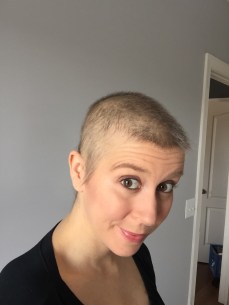
Two weeks after my first treatment, I ran my fingers through my hair and out came a handful. Within the hour, I called some friends to come over to shave my head. We made a celebration out of the event and created many styles. I had a mohawk over salad, a side shave over pizza and a nice patch in the front with a curl over dessert. No tears were shed, but there were a lot of laughs. Eventually, we shaved it down to a nice stubble and it felt great during that Nashville summer.

Even though I bought a wig and countless people sent me scarfs, I decided to be out and proud with my bald head. As if it were any consolation, I have a nicely shaped head without any Gorbachev birthmarks or funky lumps. I often forgot I was bald and people are pretty cool these days about not staring too much. A fellow survivor even bought me lunch once.

Much to my surprise, the stubble stayed and I never got Mr. Clean bald. Angry, I wondered if my shave was premature. Remembering everything, I stopped shaving my legs, until my husband said the hair was braidable. And even more annoying — that one hair growing from my chin. You ladies know what I’m talking about. I welcomed the loss of that little sucker. Nope, it never happened and I’m still plucking that rebel. Eyebrows, eyelashes and everything else remained in tact.

Halfway through my six rounds of chemotherapy, I got a two month break from chemotherapy for surgery. I was ecstatic when my hair started to grow back and continued to do so even after I resumed treatment. I thought that maybe I wouldn’t lose my hair this time. Sure enough, the day after the thought existed in my brain, I woke up to a softball-sized bald spot on the back of my head. I resolved not to do a complete shave and just let it be.

Today, I’m almost a couple months from the end of treatment and my hair is the definition of a hot mess. Picture a combination of cradle cap, a modest mullet and that terrible men’s hairstyle that looks like a wall at the front hairline. I’ve been wearing hats and oozing with jealousy at everyone and anything who has hair. This includes my German Shepherd and cat who just shed it throughout the house. I take a picture of my head every day and even though I feel my hair growing back, it doesn’t look like it in the photos. A watched pot never boils.

Having a buzzcut for the last six months is starting to take it’s toll. I am so ready to run my fingers through my hair again. No matter how many times my husband tells me I’m pretty, I still do a double take when I pass a mirror. I feel less feminine and despise how my bald head screams cancer patient. I’m ready to move on.

Who knows when my hair will grow back to what I consider a respectable length. But what I do know is that I can’t wait for one of those weekend nights, when we’re already late and my husband’s waiting for me to finish doing my hair.

Read on curetoday.com: Waiting for Hair: The Toll of Chemotherapy and Cancer

Read all my cure today.com articles.

A Chronology of Hair Loss

IMG_4023

February 10, 2016