A Vacation from Cancer


87WSyMSm

As featured on curetoday.com

Last week my husband and I traveled to the Dominican Republic for the vacation I’ve been craving since beginning chemotherapy last July. Long before we departed, a pact was made. The island was declared a cancer-free zone. There was to be no mention of the “c” word. Doing so was punishable by a contribution to the swear jar, changing the kitty litter for the rest of the year, or, the worst task of all, laundry.

We were quickly reminded what time of the year it was as the beach was packed with college students. At first, nothing made me feel more old and uncool than having a post-surgery chemo body, avoiding alcohol due to a regenerating liver and rising when our fraternity brother neighbors were coming in from a night of fun. Initially, I was a bit jealous and irritated, but I then decided the carefree and fun environment wasn’t such a bad thing. They were on spring break and I was on a cancer break.

For eight full days, we pretended as if it never happened. I read four books, napped under a palm tree, swam in the warm Caribbean Sea and tipped the beach waiter enough that I never saw the empty bottom of my drink. My husband played hours of beach volleyball and kept a diet of fresh tropical fruits. Both of us played and rested hard. It was absolutely glorious.

A break makes so much sense for cancer patients. Our bodies require rest and relaxation, especially when they’re recovering or fighting an intruder. Treatments, appointments, paperwork, recovering and medications alone are all exhausting. Throw in a job, family or anything else, and fatigue and stress are two things that are guaranteed. And what happens when we’re stressed and fatigued? Our immune system is lowered, leaving us more susceptible to disease. Workers are given vacation time to avoid burnout and recharge their batteries. Students are given breaks to rest their brains. If anyone needs or deserves some time off, it’s cancer patients and their families.

Now, I know everyone can’t take a vacation or a cancer break. When I was in treatment, I had several appointments a week, making a getaway impossible. And when I wasn’t at the hospital, I felt horrible. Also, cancer can devastate finances and the ability to earn income, making a trip low on the priority list compared to paying for treatment and living expenses. So, if these situations apply to you, let me pull out my magic wand, wave it around your current space and hereby declare you on a cancer-free island.

Now go make yourself a drink and do something fun for the next hour, day or week. Remember, no mention of the “c” word.  And most importantly, enjoy. You deserve and need it!

To read more of my Cure articles, click here.
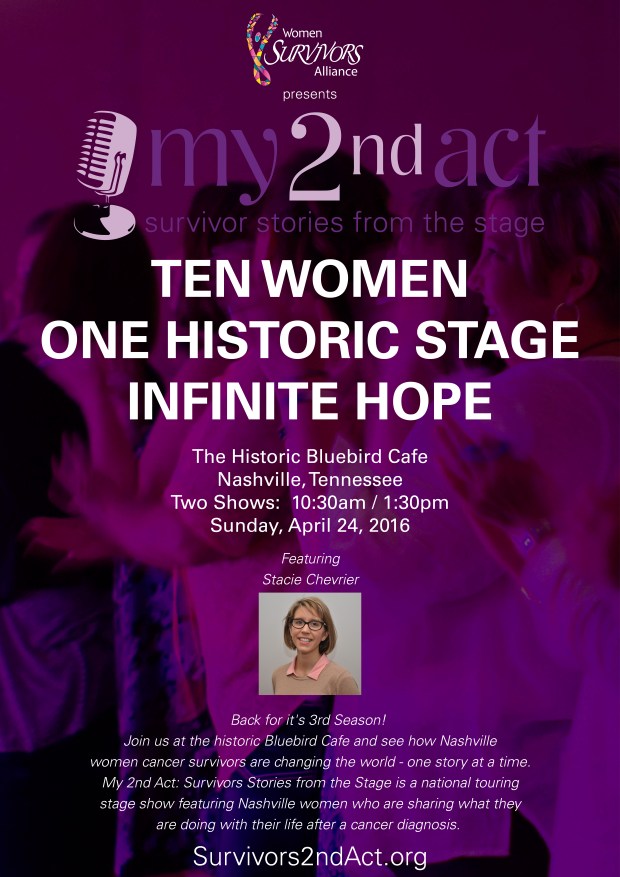


My 2nd Act: Bluebird Cafe Performance

I’m excited to share that I’ll be reading a personal essay on April 24th at the Bluebird Cafe as part of a show called, My 2nd Act: Survivor Stories from the Stage.

My 2nd Act: Survivor Stories from the Stage is a professionally produced stage show hosted at theaters around the country.  It’s a celebratory, inspiring and empowering event full of emotions – both for the survivors and non-survivors in the audience.

This week was our first table read and let me just say – OH! EM! GE! These women are on another level. Their stories include overcoming an unimaginable loss, housing the homeless, surviving a terriorist attack and a teenager, who, mark my words, is the next Oprah Winfrey. Oh, and all these ladies survived cancer too.

If you’d like to see the show live, details are below:
Sunday, April 24th at 10:30 a.m. and 1:30 p.m
Tickets are $32.49 can be purchased here. Sales benefit the Women’s Survivor Alliance.
The Bluebird Cafe is very intimate (i.e., small) and only 90 seats per show are available. The event will sell out, so if you’re interested, be sure to buy your tickets ASAP.

Nashville_M2A_A1_StacieChevrier_RGB_160325-01

Performing at the Bluebird Cafe is a huge honor. After the Grand Ole Opry and Ryman Auditorium, it is the most famous music venue here in Nashville. It’s where country artists test out songs they’ve written and aspiring musicians hope label reps are in the audience, as they often are. Garth Brooks and Taylor Swift were discovered there and anyone who’s anyone in country music has preformed on the stage at one time or another. So, I’m excited for the opportunity to share the stage not only with some unbelievable women survivors, but also some pretty famous footsteps. A complete history of the Bluebird Cafe can be found here.

If you’re not local or can’t make it, the show will be filmed and I’ll share the video as soon as it’s live.


Thanks!

Creating My Cancer Posse

87WSyMSm

As featured on curetoday.com

When diagnosed, I ate up books by inspirational survivors who shared their tips and tricks for making it through the cancer maze. One of my favorite cancer surthrivers is Kris Carr, who starred in the documentary “Crazy Sexy Cancer” and went on to write several books on healthy living, such as “Crazy Sexy Cancer Tips.”  I flipped it open and agreed with every sentence, up to the part where she suggested I create a “Cancer Posse” consisting of other survivors like myself. Immediately the record player in my head scratched and I said, “No thanks, not for me.”

Before cancer, I considered myself pretty tough. I ran a marathon, placed first in a sprint triathlon and hiked across a country carrying everything on my back.  I’ve always enjoyed my solitude and these achievements were completed alone and by choice. So, when several people suggested I join a support group, it sounded like self torture. Plus, my perception of cancer survivors was that they were thin, sad, sick, bald, weak people and I cringed at the thought of sitting in a church basement, in a circle of tears asking, “Why me,” while others rubbed my back. Those are not my people, I thought.

(Keep reading – I’m going to eat my words.)

However, I was thirsty for information and found an online group of other pancreatic neuroendocrine tumor survivors on Inspire.com. Without even realizing, I had joined a support group. After a month of participating in online discussions, the members encouraged me to seek a specialist. Their insistence and physician recommendations resulted in a consultation with one of the top neuroendocrine cancer doctors in the country, who provided me with a good game plan. I thought of support groups as outlets for emotions, but the fact that they could be a place to exchange valuable information had never occurred to me. In my case, I found this online group to be more knowledgeable about my disease than most doctors.

Then a year ago, I got pretty sick from cancer and treatments. My friends and family were desperate to help, but none of them really understood what I was going through. Cancerland had a population of one and left me wishing I would’ve created that cancer posse.

One day, in the midst of my treatment chaos, I posted an update on Facebook and an acquaintance from long ago immediately sent me a message sharing her story and offering support. I knew she had also been through treatment and could relate. From that point on, we exchanged messages and texts checking in on each other. Eventually, she came to town and we met up for two hours and talked non-stop about cancer, commisterating about doctors, wait times, side effects and weird things that happened to our bodies. Wow, did it feel good! I had the first official member of my cancer posse. Since then, this friend moved to my city and I’ve added a couple more members to my crew. I hang out with these friends all the time and we almost never talk about cancer. Not only do they make me feel less self conscious about my unusually short hair and protruding chest port, but it’s comforting to be a phone call away from someone who gets it.

So, I hereby retract my disdain for support groups. These days, they are much more than sitting in a circle and crying. They provide a sense of comradery, make you feel less alone, share helpful information and are full of people who have deep empathy. I realized your posse doesn’t have to be traditional. It just has to be one that works for you.

As for me, I still haven’t joined a live, local support group, but I have my own, unconventional posse consisting of a small, select group of friends and hundreds online in the neuroendocrine cancer community who are always to happy to share their decades of wisdom.

Now, let me publicly apologize to anyone who has ever faced cancer for calling them thin, sad, sick, bald and weak. Before diagnosis, I considered myself very strong, but chemotherapy and cancer brought me cowering to my knees. If I had only known then, what I know now, that cancer fighters are some of the strongest, baddest, toughest people on this planet. I’m humbled and grateful to be among them because they are my people.

Read my other Cure articles here.