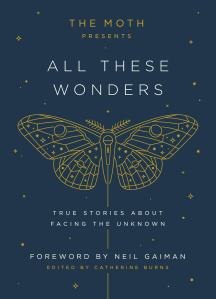
Review: All These Wonders

imagesAs a writer, I am reading all the time. Recently, my entire library waitlist came in at once and I found myself picking up fifteen books – all due back in three weeks. Geez, Louise, I better get busy.

What fills me with amazement is how the right book always lands in my palms at the right moment.  The universe just seems to know what we need and when we need it.

Let me share an example.

Last month, I traveled to Michigan to spend the week with my 86-year-old grandmother to hear any story she was willing to share with me about her life. I brought the two books that arrived at the library the day before I left, Moonglow and The Rainbow Comes and Goes.  I had no idea their premise but reserved them based on a recommendation. “Coincidently”, both stories were about characters spending time with an elder in their family. I can’t really explain it, but that’s just how these things work.

With a generous selection on my shelf, this week, I grabbed All These Wonders, a compilation of short stories previously performed at The Moth storytellers series. And wouldn’t you know it, the subtitle is, True Stories About Facing the Unknown. An especially relevant subject since I was dealing with facing some unknown myself this week.

So, I’ll share a few stories from the compilation that I think cancer survivors and/or anyone impacted by illness might appreciate. What I love about these stories is not the common theme of disease, but what happens before, between and after the character’s confrontation with disease. Reading these reminded me, it’s not illness what makes our stories wonderful and interesting and worth reading and hearing – it’s the moments in between and after illness enters our lives. However, the irony of it all is that without those bitter moments of illness, the moments in between and after would not be as sweet.

Ugh, it’s a double edged sword, people.

I hope you enjoy these wonderful stories and that they come into your life when you need them the most.

FAVORITE: It Matters A Great Deal by Kevin McGheehan
A son plans the party of a lifetime for his mother.

SUPER COOL: Who Can You Trust by Mary Claire-King
A doctor battles through heartbreak to make a breakthrough in cancer research.

SWEET: Kidneys and Commitments by Gil Reyes
A man receives the best gift ever from the love of his life.

10 Lessons for the Newly Diagnosed

Anytime a friend or family member knows someone newly diagnosed, they get sent my way. I love this because I believe in mentorship, but I hate it because it’s a role I never wanted. Actually, I don’t think anyone wants this job.

When I connect with the referral, I often find they’re looking for words of wisdom and my reaction is, You’re coming to me? OMG! I have no idea what I’m doing. But, when I take a step back and meditate on the years since my diagnosis, I realize that I have acquired a significant amount of wisdom on navigating the maze, so below you’ll find some of my biggest lessons learned along this crazy road:

  1. Prepare for bad days. They’re inevitable. I created a list of things to do on when cancer or life gets me down. On my list: take a walk, call a friend to hang out, go to yoga or for a run, watch Jimmy Fallon Lip Sync battles, you get the idea. Doing these things doesn’t always turn a bad day good, but aides in soothing me so it’s not as torturous. But guess what, there will be good days too. Enjoy those.
  2. Choose your vocabulary. I hate being called a “cancer patient” and prefer “cancer survivor”, which I assigned to myself on diagnosis day. I also decided not to claim cancer by choosing to refer to it as “the” cancer and not “my” cancer. Sure, it’s a play on words, but words matter and have power. I often roll my eyes at cliche verbs such as fighting, battling and nouns like warrior, but I can see where others find great power in these words. This is your experience and you get to choose the words to describe what you’re going through – not prepackaged phrases or cliches.
  3. Limit your research. Yes, you read right. Google’s search results can be overwhelming. While being an informed patient is critical, there comes a point where it’s too much. Set a timer for an hour, do your Googling and then go live your life. It might even be helpful to plan your research at a specific time of day. I don’t Google in the evening. Otherwise I stay up all night thinking. I Google before something fun, so my mind does not dwell on the results for too long.
  4. Prepare to learn the meaning of friendship. There were people who showed up for me, who I considered acquaintances before illness. They were people who called, texted, sent me cards, cooked me dinners and took me to appointments. Words cannot express my gratitude for these angels and I would go to the ends of the earth on their behalf, as they did for me.There were also friends I considered close, who went missing in action. I’d be lying if I said it didn’t hurt. I understand – cancer is uncomfortable and not fun, but I now know the true meaning of friendship.
  5. Think about what you will do on the other side. I can not accept that we are given these obstacles for no reason. I think it’s important to discover meaning or the lesson in a traumatic experience. Do you want to help others affected by the disease? Awesome. Or do you want to erase the experience from your memory? Totally understandable. Whatever category you fall into, do something! Take the trip you’ve been talking about for years. Write the book. Run the marathon. Jump out of the plane. Make amends with the family member. If cancer teaches us anything, it’s that there are no guarantees, so minimize your chances of regret.
  6. Get a therapist. Your doctor is leading the team on physical healing, but you can not ignore the mental, emotional and spiritual aspects. Cancer is a torturous mental challenge and having an outside opinion has been instrumental to me. Ignore this and you’ll miss important aspects of healing. Plus, it’s sometimes difficult to talk to those so close to you about big fears that accompany the disease since they themselves are so emotionally invested in you.
  7. Find a support group. It does not have to be traditional. It just has to work for you. I still have never been to one where you sit in a circle and cry, but I have met countless lifelong friends through a weekly writers workshop and a young survivors non-profit. I also participate in an online group of people with the same disease. It’s here where I found my specialist and often research treatments. I always thought of support groups as therapy, but they can also be a wealth of information.
  8. See a leader. No one will hold your best interests at the top of their mind the way you do and having the right doctor is game changing. Life saving, in fact. Don’t settle on the first doctor who crosses your path. Visit at least two or three. More if your case is rare. Find someone who’s doing research on your disease and not someone who’s following the pack. It took me several opinions to find a specialist who knew what to do with a one in 10 million diagnosis, but once I found him, my world changed. He disagreed with all the previous opinions and I know I am alive today because of his experience. I travel from Nashville to New York City to see him every six months and often look forward to hearing the research in his pipeline.
  9. Be relentless. It is exhausting and the only time I’ll ever refer to disease as a fight is in reference to navigating the medical maze. My doctors call me relentless and I take it as a compliment. I do not leave them alone (respectfully) and because of this, they return my call or email quick.
  10. Practice gratitude. It wouldn’t be a post from me, if I didn’t mention gratitude at least once. There will be days it will be hard to be grateful for anything, but believe me when I say, there is always something to be grateful for, even if it’s being alive, which is a privilege denied to many. Write these down. Re-read them when times are tough.

I’ve also learned these lessons are constantly shifting, evolving and revealing themselves. Cancer survivorship is a process and I am a grateful participant.  I wish the same for you.

Read my other Cure articles here.

So Many Activities

One of my goals this year was to post weekly blogs. Like many people, by mid-February, my New Year’s resolutions began to lag. While my good intentions were there, the mental space and energy was not.

So, if I haven’t been posting, what the heck have I been doing?

The answer – so many activities!

First and most important – I’ve devoted countless hours to an essay I started nine months ago. I’m happy to share it has (finally) been submitted for consideration to the New York Times, Modern Love column. I put a lot of time and energy into the piece.  I’ve never been more proud and more sick of something. The column has a one percent acceptance rate. Yeah, the chances are slim.  However, the Editor reads every single essay and I think it’s pretty darn cool a New York Times Editor will be reading my work within the next 2-3 months. Yes, it takes a long time.  Please say a little prayer on my behalf to the Editor Gods. Accepted or not, I will share it on my blog as soon as the Times gives me the green or red light.

If you haven’t heard of the column, it’s guaranteed to warm even the coldest of hearts. Here are the most popular essays and a few of my favorite podcasts:

I’ve also continued my quest toward minimalism. The Minimalists even shared my post about Cancer and Minimalism on their Facebook page, which was pretty sweet. Otherwise, our entire house has been cleaned out and organized. We made over six trips to Goodwill where we donated fifteen boxes and bags. I’ve since moved on to tackling digital clutter. The biggest achievement has been reducing 25,000 photos down to 2,500. My goal was also to do “Internet Free Sundays”. It failed miserably and Fabien is grateful. In April, I’m looking for someone to play the Minimalist Game with me. If you’re interested, send me a message.

What’s next?

I’m currently working on a few more cancer related blogs, which I’ll share here in the coming weeks.  And the biggest news of all – next week, I’m starting research on a subject which I hope will turn into my first book. I am excited and terrified. Stay tuned for more.

Otherwise, I want to share a few things that are rocking my world:

  • Podcast: Missing Richard Simmons. Filmmaker, Dan Taberski, is on a quest to find out what happened to Richard Simmons and why he all a sudden fell of the face of the earth. It’s fascinating and strange.
  • Podcast: The Forward. Much to my suprise, Lance Armstrong is actually a pretty great interviewer and interesting subject himself.  In The Forward Podcast he talks with everyone from Malcolm Gladwell to Rahm Emmanuel to Neil deGrasse Tyson to Bo Jackson. It’s quite entertaining.  Love him or hate him – you have to tip your hat to a guy who raised millions for cancer research.
  • Podcast: The Minimalists. Are you seeing a theme? The podcast is almost better than the Netflix documentary.
  • On Writing: A Memoir of the Craft by Stephen King. I’m late to this party since the book was published in 2000. If you ever write anything (ever), you should check out this book. It’s a master’s degree in itself. Plus, King is an impressive guy and the stories behind his stories are captivating.
  • Die Young With Me. I’ve read a lot of cancer memoirs, but this one is by far the best because of it’s raw honesty. By pure coincidence, the author, Rob Rufus, lives in Nashville.

Lastly, someone, somewhere shared my blog and my readership has gone through the roof. Whoever you are – THANK YOU FOR SHARING AND READING!  I’m also on Twitter at @staciechevrier.

I hope everyone is off to a great 2017, living large and doing so many fun activities:

Bonus cool points if you knew “so many activities” came from the movie ‘Step Brothers’: